
Commercial Roof Flashing Repair in Lafayette, LA
Home / Roof Damage Repair / Commercial Roof Flashing Repair
Talk With Our Lafayette Team
Point out the stain or loose detail. We will inspect the flashing, check nearby roof materials, and explain the repair needed.
Call 555-555-5555
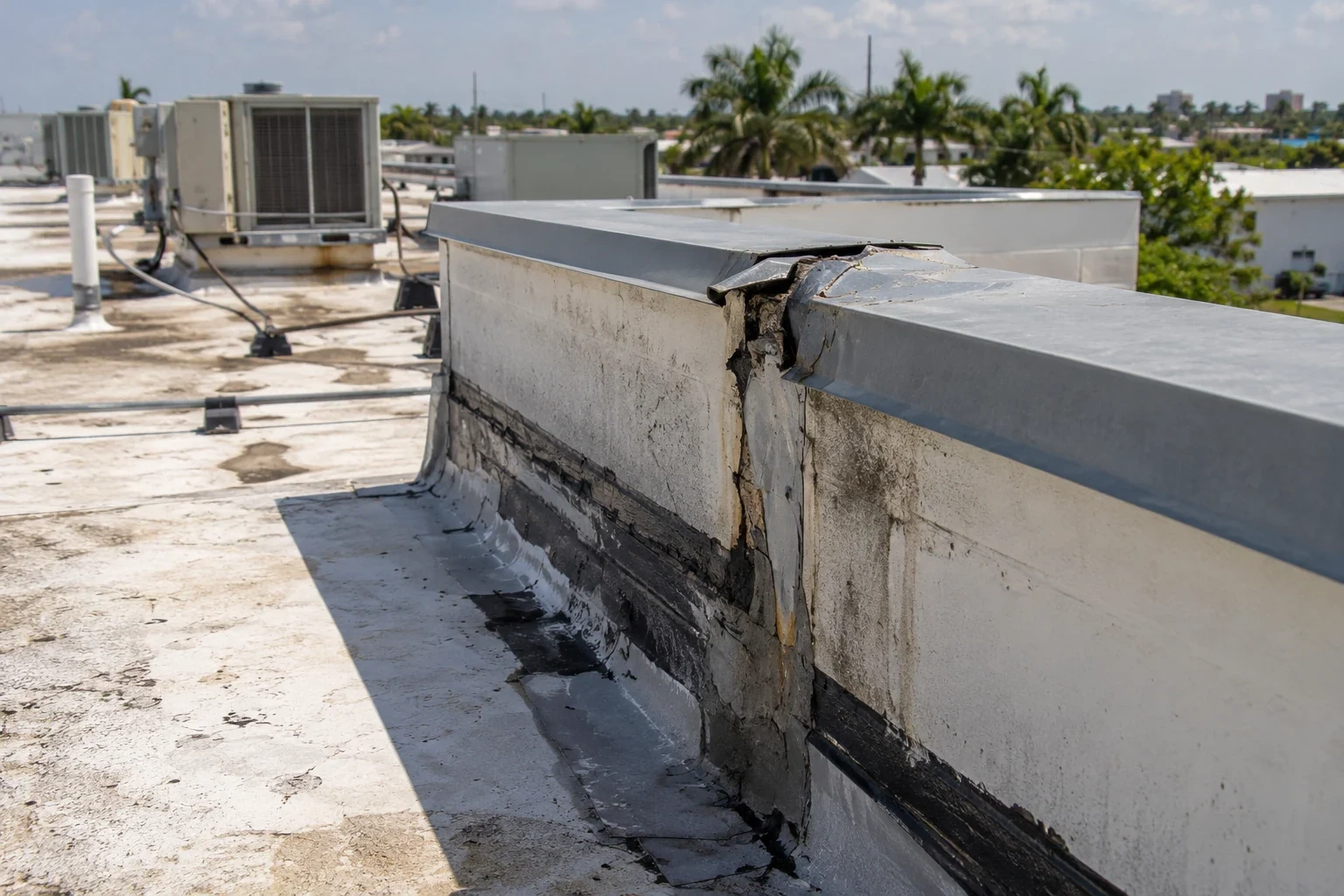
Get the curb or penetration checked
A ceiling stain beside a rooftop unit may come from the curb, the membrane, or a seam above it. The flashing is where those parts meet, and small openings can carry water into insulation long before a leak appears indoors. We inspect the transition itself, then follow water marks and moisture readings to set the repair limit. Lafayette receives frequent heavy rain, and the airport climate normals record 60.50 inches of annual precipitation. That makes a loose corner or split sealant worth checking before another wet spell, especially where equipment, pipes, or walls interrupt the roof surface.
Flashing repair is specific to the assembly. We identify the membrane, curb height, substrate, existing patch layers, and any movement around the penetration. Then we explain whether a local patch, a new flashing detail, or a broader membrane section is needed. If a storm has opened the transition, our storm damage roof repair process documents the surrounding roof too. A wider inspection may include skylight and penetration flashing work across several roof zones, or membrane puncture repair near damaged equipment access.
Look at the joint, not just the stain
We start at the top edge of the flashing and work down. At a curb, that means checking corners, membrane attachment, counterflashing, fasteners, and the point where the unit support meets the roof. At a pipe, we look at the boot or field-fabricated collar, its bond, and the membrane below. At a wall, we follow the base flashing and termination bar. A bead of sealant may hide an open joint for a while, so we check whether the underlying material is still bonded.
Interior evidence helps direct the inspection but does not settle the cause. Water can travel over the deck or framing before a stain forms. We photograph ceiling marks, note their location, and compare them with curb corners, seams, and drain paths above. A moisture survey can help map wet insulation where conditions permit. Infrared findings are paired with close inspection so heat patterns are not treated as proof on their own.
At the Johnston Street-Louisiana Avenue corridor, city plans describe an 8.5-mile route connecting businesses, schools, UL Lafayette, and neighborhoods. That variety illustrates why access and occupancy differ by property. We ask whether the room below contains equipment, patients, customers, or office staff, then plan protection around the actual use.
Separate failed sealant from failed flashing
Sealant is not a substitute for sound flashing. It can split from age, movement, ponding, or a surface that was dirty when applied. The sheet metal or membrane beneath it may still be serviceable, or the whole detail may have lost adhesion. We remove only what is needed to inspect the joint and avoid building another patch over an unknown stack of old repairs.
Movement matters at equipment curbs. Vibration, service access, thermal expansion, and roof flex can pull at corners and fasteners. We check for loose counterflashing, lifted membrane, cracked boots, corrosion, and wet cover board. If foot traffic has damaged the nearby membrane, the repair needs to cover that area as well as the transition. A narrow patch that leaves a compromised lap nearby can simply move the leak.
Our report marks what is confirmed and what remains concealed. If a small opening is needed to verify the substrate, we explain its location and the work required to close it. Lafayette's 2021 International Existing Building Code is listed by the city for existing-building work; the applicable project requirements depend on the scope and local review. We can document the repair detail for the owner or project team without claiming a permit outcome.
Match the repair to the roof material
On TPO or PVC, the patch and flashing membrane must be clean and compatible for a reliable weld. EPDM details use their own primers, tapes, and molded accessories. Modified bitumen and built-up roofs call for asphalt-compatible materials and careful tie-ins. A metal roof transition may require a new boot, formed metal, fasteners, and allowance for panel movement. We confirm the assembly before pricing the repair.
If the curb is sound and only one corner has opened, a focused repair may restore the detail. If the membrane is brittle, insulation is wet, or prior patches cover a wider failure, replacing a larger section may make more sense. We outline the repair boundary, access needs, material cure or weld conditions, and any interior protection. For the compatible system options, we can compare TPO roofing and EPDM with the installed assembly.
At Our Lady of Lourdes Regional Medical Center, hospital operations continue around the clock. That use highlights a practical point for any healthcare property: roof access and noise need coordination with the facility contact. We do not infer that a specific curb has failed. We plan the work around the building's operational needs once the owner identifies the work area.
Reduce repeat leaks at roof penetrations
Keep a roof map of curbs, pipes, vents, and skylights. After mechanical work, confirm that the roofing detail was restored and that loose packaging or fasteners did not remain nearby. During maintenance, inspect transitions for cracks, lifted corners, open laps, and movement. Our preventive roof maintenance visit can record these details before the next leak report.
Routine service should distinguish a surface sealant touch-up from a true flashing repair. We identify the product and substrate, remove failed material where needed, and install a compatible detail. If water has reached insulation, we find the affected limits before closing the surface. An infrared scan or targeted opening may be appropriate, depending on roof construction and access.
We also record which equipment must remain in operation and who can authorize shutdowns. A building near Downtown Lafayette may have a different service route and tenant schedule from a business park. That is why we discuss access with the property contact before placing materials or opening the roof. Photos and repair notes help the next maintenance visit start with a useful history.
Know what was repaired and what remains
Closeout photos show the finished flashing and the surrounding seam. We note the membrane type, repair materials, moisture findings, and any adjacent condition left outside the scope. If we found wet insulation or a second weak transition, the report identifies it separately. This gives the owner a clear record for future service calls and roof planning.
For a larger roof review, a condition report with photographs can group findings by roof area and priority. When flashing failure accompanies a split lap, we can also repair the open seam that allows water to travel past the transition. Arrange an inspection if sealant has pulled away, a curb corner is soft, or a stain returns after rain. We will trace the detail and explain the repair window. A hail damage inspection checks a different set of surface impacts.
Questions About Commercial Roof Flashing Repair
Can new sealant stop a leak at a rooftop curb?
It can help only when the flashing beneath it is sound and the surfaces are compatible. We inspect the joint, remove failed material as needed, and identify whether the curb or membrane needs a larger repair.
Why does water show up inside away from the curb?
The deck and framing can carry water before it reaches a ceiling. We compare the stain with roof seams, curbs, drains, and moisture readings to find a likely entry path rather than patching directly above the mark.
Do you need to shut down rooftop equipment?
The equipment and repair detail decide. Some curb work can proceed while a unit runs; other scopes need a shutdown or a service window. We coordinate that decision with the building contact before starting.
When should the flashing be replaced instead of patched?
Replace a wider detail when the membrane is brittle, the substrate is wet, the flashing will not bond, or prior patches hide the actual failure. We document those conditions and explain the repair boundary.
Can you repair flashing on a metal roof?
Yes. We inspect panel movement, fasteners, boots, and formed metal, then select a detail that fits the roof material. A membrane patch is not the right answer for every metal transition.