
TPO Roofing in Lafayette, LA
Home / Roof Systems / TPO Roofing
Talk With Our Lafayette Team
Tell us where you have seen water, a lifted seam or a recurring repair. We will inspect the membrane and drainage details, then explain a practical next step for your Lafayette building.
Call 555-555-5555
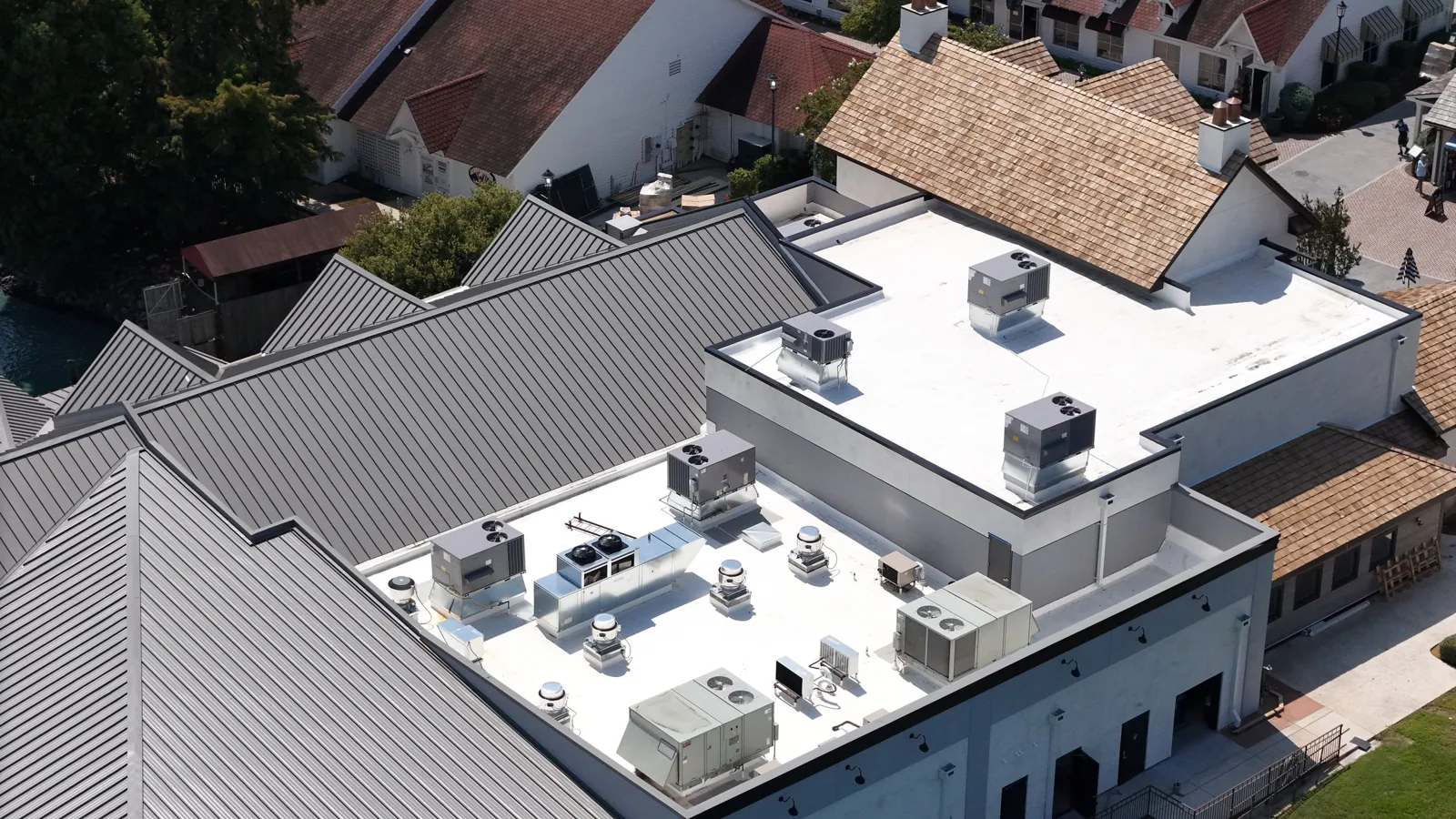
Get a close look at your TPO roof
A TPO roof can look smooth from the parking lot while a seam or curb detail needs a closer look. Heat, rain and foot traffic all leave different clues on a low-slope assembly. In Lafayette, we inspect the membrane, welded laps, flashing and drainage before recommending a repair or replacement. The roof's age and repair history matter, but neither tells the whole story.
That review is useful for facilities along the Johnston Street-Louisiana Avenue corridor, near the Lafayette, and in the LEDA Industrial Park. Their roof layouts and daily use differ. We tie the recommendation to the actual membrane, substrate and water path rather than treat every white roof as the same system.
Read the membrane surface
TPO is a single-ply thermoplastic membrane. Installers join sheets with hot-air welds, then detail corners, curbs, pipes and edges to keep water outside the assembly. We look for open welds, fish-mouths, cuts, wear, loose terminations and separated patches. Discoloration alone does not prove failure; we check for cracks, splits, lifting or ponding.
We also note whether the field sheet is taut or bridged over an uneven substrate. Movement can stress seams and flashing. A surface repair may leave wet insulation untouched. If interior staining has been reported, we compare its location with roof details above and account for the route water can travel before appearing indoors.
Lafayette Regional Airport's long-term climate table shows July and August mean daily highs above 92 degrees. Heat exposure is part of the local roof environment, but sunlight, shade, surface condition and assembly details vary from building to building. We record what the specific roof shows and avoid assigning a cause from climate alone.
Check welds and transitions
A TPO seam depends on proper welding and a clean, compatible surface. We inspect lap edges for lifting or incomplete fusion and look at patches that cross seams. Corners and changes in plane deserve individual attention. A curb has vertical flashing, a top termination and corners; a wall has a different transition. A small opening may admit water while the field stays intact.
Equipment service can add cuts, fasteners or unsupported movement. We ask whether a recent mechanical visit changed the detail. If a pipe support presses into the sheet or a conduit base interrupts runoff, the repair needs to account for that condition. Our curb and equipment-support work can address roofing transitions while the equipment trade handles its own connections.
Edges matter too. Loose metal, exposed termination points and wind-related movement may affect how the membrane ends. If a storm has damaged the perimeter, we document the roof-side evidence before setting a scope. Lafayette has documented hurricane preparedness and severe weather, but a particular roof still needs visible evidence before a storm-related cause is assigned.
Follow the drain path
Water can sit near a seam, travel under a lap or reach an interior mark from a distant opening. We check drain bowls, scuppers, overflow routes and low areas while reviewing TPO details. Lafayette airport normals record 60.50 inches of annual precipitation, with June the wettest month at 7.08 inches. We confirm actual slope and outlet condition on site.
A blocked drain may need cleaning. A settled area may require a more involved correction. A membrane repair will not correct a low spot that repeatedly holds water, and coating over a wet assembly can trap a separate problem. We describe what we observed and distinguish a maintenance item from a roofing repair. For drains and scuppers, a drainage-detail inspection can identify the work needed to restore the intended path.
If moisture is suspected under the sheet, the surface alone may not show its extent. We can discuss infrared moisture mapping or other verification before replacement planning. We interpret test results with repair history and visible conditions.
Choose a repair that fits the TPO
A small puncture, open seam or failed flashing can sometimes be corrected without replacing a larger roof area. We clean and prepare the membrane, remove incompatible material where needed, and use a compatible TPO repair detail. The patch should extend onto sound material and address the point of entry. The scope also considers adjacent seams and drainage, so a repair is not sized only to the visible mark.
Repeated seam failures, widespread brittleness, saturated insulation or deteriorated deck may change the decision. We can document the condition and compare targeted repair with a broader project. If the membrane remains suitable but needs restoration, coating restoration may be reviewed only after confirming adhesion and system compatibility. For a new assembly, replacement work allows insulation, flashing and edge details to be considered together.
Our written notes identify the roof area, observed defect, materials proposed and any concealed condition that remains unknown. If the inspection cannot determine whether insulation is wet, we say so and describe the testing needed. That gives an owner a real decision point instead of a repair recommendation based on a single surface photograph.
Compare TPO with the building's needs
TPO is one option among several single-ply and multi-ply systems. A building's use, rooftop traffic, exhaust exposure, insulation requirements, edge configuration and maintenance access affect material selection. For some projects, PVC roofing or KEE membrane may be considered. We compare their product requirements with the project details.
On metal buildings, the roof profile and fastener layout can point to a different path. A standing-seam system is not interchangeable with a low-slope TPO assembly. A metal roof restoration may be evaluated when an exposed-fastener roof needs restoration. The existing substrate, attachment, water path and desired service life guide the choice.
Mixed-use places in Lafayette include downtown and Johnston near Acadiana Mall. Business parks such as LEDA Industrial Park support a different mix of activity. These names provide local context, not a shortcut to material selection. We inspect the roof on the property and account for how the building operates.
Keep a useful roof record
After repair or installation, routine observation helps catch changes before they spread. A maintenance visit can look at seams, terminations, penetrations, drains and service routes. Roof access should be controlled so other trades do not leave cuts or unsecured materials. Photographs tied to roof locations help the owner compare a later condition with the prior record.
We can document observed items in a roof condition report and discuss a schedule suited to the building's use. A campus or multi-tenant property may need location labels that maintenance staff recognize. The Johnston Street-Louisiana Avenue corridor connects businesses, schools and UL Lafayette along an 8.5-mile route. Properties there still need their own roof map, access notes and repair history.
Call when a TPO seam lifts, water appears inside or a recent service visit changed a roof detail. We can inspect the affected area, explain what the membrane shows and outline a repair or system decision. Emergency response is available nights, weekends and holidays when active water entry threatens the building.
Questions About TPO Roofing
How can I tell whether a TPO seam has failed?
A lifted edge, open lap or separation at a patch deserves a close inspection. We check the weld and nearby sheet condition, then look for water evidence below. A surface mark alone does not tell us whether the seam is the entry point.
Can a TPO roof be repaired after a leak?
Yes, when the membrane and surrounding assembly can accept a compatible repair. We identify the source, check adjacent details and note any wet insulation or broader deterioration before defining the repair area.
Does ponding mean the TPO membrane needs replacement?
Standing water calls for a drainage review, but it does not by itself establish that the membrane has failed. We inspect the low area, outlets and seam condition, then separate maintenance, slope correction and membrane work.
What should we compare before choosing TPO for a replacement?
Look at building use, rooftop equipment, foot traffic, drainage, insulation and detail requirements. We can compare TPO with other systems and explain which factors matter for your roof and project documents.
Can you respond if water is entering after business hours?
Our emergency response runs nights, weekends and holidays. We can assess the active condition, protect the affected area where practical and explain the permanent repair after the roof is safe to inspect.